

Pricing isn’t just a number, it’s a narrative. It tells your customers how you value your product, how you expect them to engage with it, and how you intend to grow. Whether you’re offering a one-time fixed fee, charging by volume consumed, or layering in subscriptions and hybrid models, each pricing strategy carries implications for product design, financial reporting, and customer perception. In this blog, we’ll break down the core pricing models, explore how they shape financials and revenue recognition, and examine how different buyers interpret value. Because pricing isn’t just about what you charge, it’s about how you build trust, drive adoption, and align your business with the market it serves.

How are they defined
Fixed pricing
A one time pricing fee, charged initially for the use of the product and/or service where the customer has the right to use as extensively as they wish without any additional charge. In this pricing model it is essential that the product or service, is defined with a very specific packaging, transparent, concise and easy to understand.
Volume pricing
A variable pricing fee, that is determined based on the actual consumption of a product where the customer is first consuming the product and is then charged based on that actual usage consumption. In this pricing model it is essential that the price metric is measurable, expandable over time and easy to predict. Various volumes of usage can have a single price point per unit or be tiered into different volume buckets and priced at each tier or even on a cumulative tiering to maximize pricing at high volumes.
Subscription pricing
A recurrent pricing fee, that can be based either on a fixed pricing model or variable from one period to another under the usage based pricing model. A hybrid model of the two is also feasible.
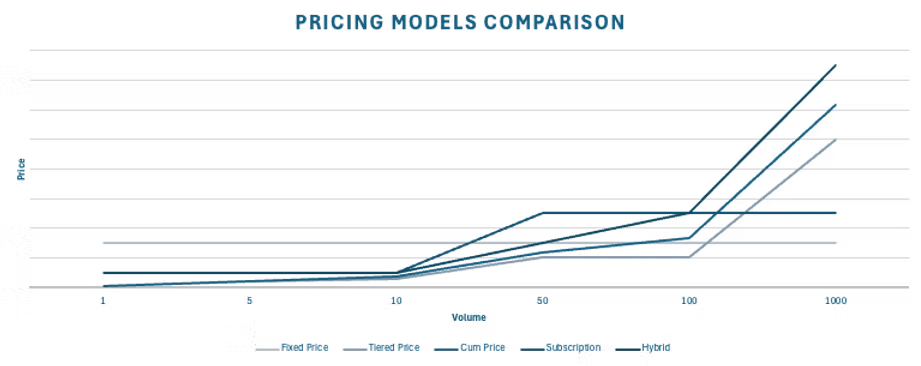
Table 1. Price against volume under the fixed and different volume based pricing models.
How they impact financials
Financials
Another key aspect to consider for these pricing models is the financial impact they have on a customers financials.
- CapEx: Capital expenditures (CapEx) are purchases of significant goods or services that will be used to improve a company’s performance in the future. They are typically for fixed assets but also for intangible assets such as patents and other forms of technology. They are reported on the Balance Sheet and they can be depreciated over time.
- OpEx: Operational expenditures (OpEx) are purchases occurring for running its day-to-day operations. As such, they don’t apply to any costs related to the production of goods and services. They are reported on the Income Statement and they are deductible from taxes however they are not depreciable.
Revenue Recognition
Under IFRS 15 revenue is recognised when a product or service is fully delivered and accessible for consumption by the customer.
- Fixed: Recognised when the customer has full access to the product and service as set within a contract. Billed and Recognisable upfront.
- Volume: Recognised when the customer has consumed some usage of a product. Billed and Recognisable at the end of the consumption period of a product.
Note: Even if from an accounting perspective it is preferred to mimic a pricing model to the cost model, that is products with variable costs with variable pricing and so on, however it is observed that revenue maximization comes from a hybrid model as it considers the strategy and market dynamics of the product. (see Table 1)
How they are perceived
It is also important to understand your consumers and how they perceive different models. Who are they and how do they spend their budget? Others have strict and fixed budget resources, while others consider a per consumption pricing model more fair and relevant to their business model. This is also where Pricing A/B activities are helpful to maximize the value perception to your consumers.
The rule of thumb has been the larger the customer, the longer the budget cycles and hence the longer the term preferred, where fixed pricing or multi year subscriptions are usually seeked.
In a summary
There is no single answer to which is the best pricing model, as each one of them responds to different market needs and strategies. In all certainty a combination of all models maximise your consumer outreach (addressing all spender types), and eliminates your financial risks from contractions and churns. Remember to consider all data and not only your benefits but also the ones of your consumers!
